

This is the exact process I use every day to find profitable NBA player props. There’s nothing automated here and I’m not blindly betting anything. This is about using data correctly and then applying context so you are not betting trends that no longer exist.
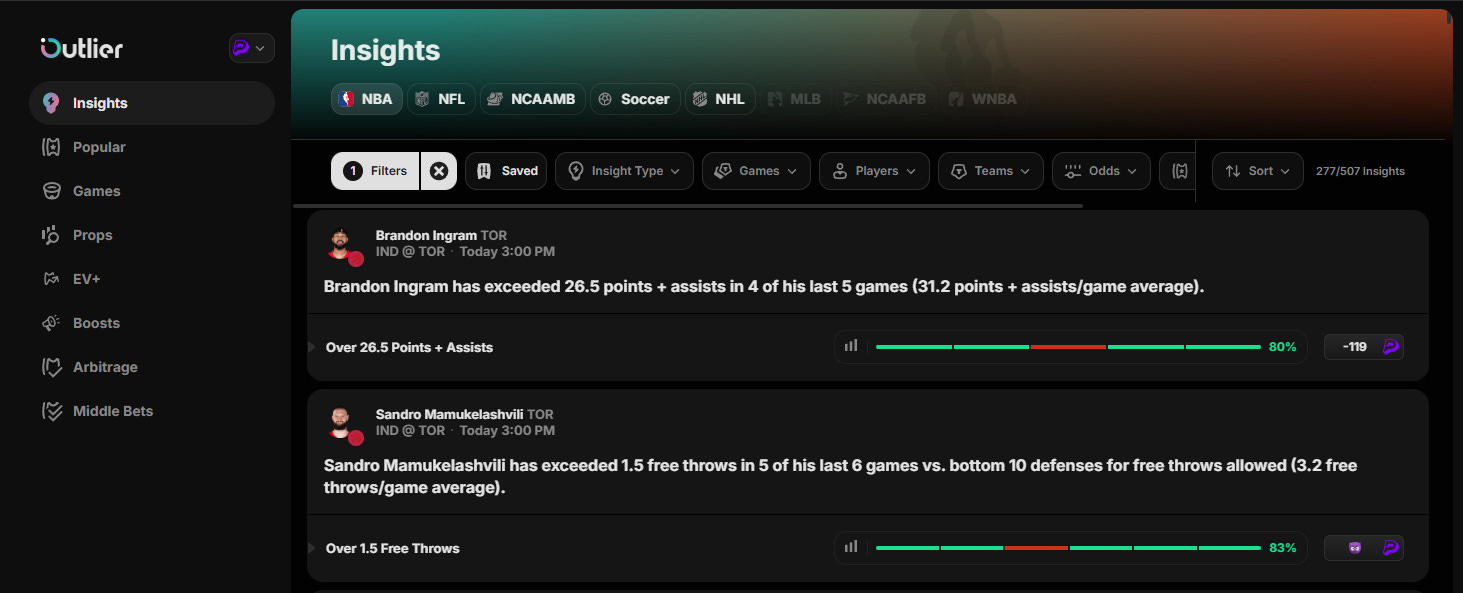
This also is not the full extent of my research. This piece is specifically about the Insights tab on Outlier.Bet I use the Insights tab as a starting point and a shortcut to quickly surface opportunities that already align with home and away splits. From there, everything gets validated manually.
Outlier is just a tool. If you don’t apply context, it won’t make you money by itself.
Using Outlier the Right Way
Outlier pulls lines from multiple sportsbooks and compares them against recent performance and situational data. That data alone doesn’t mean anything unless you understand why it’s there. The value comes from understanding why a number looks the way it does and whether that trend actually applies tonight.
I do not open Outlier looking for picks.
I use it to find spots where the line doesn’t seem to match the role..
If you prefer seeing this process instead of just reading it, I put together a full video walkthrough that follows this guide step by step and shows exactly how I use the Insights tab in real time.
Free 7 Day Trial to Outlier
If you want to follow this process yourself, you can use Outlier for free.
I have a link that gives you a 7 day free trial so you can explore the Insights tab, player cards, and filters without committing to anything. That is more than enough time to make enough money to pay for a full subscription.
If you are serious about learning how to find your own props instead of copying screenshots, this is the best place to start.
You can find the 7 day free trial link here.
Step One: Filter the Correct Books
I only look at the books I actually bet on.
Underdog Fantasy
PrizePicks
Sleeper
Everything else gets removed. If the line is not available where I am placing my bets, it does not matter. Depending on your location, your list of books/apps may be different from mine.
Step Two: Player Props Only
Insight type is set to Player.
I am not interested in team trends or game level data here. This process is strictly for player props. That keeps the data clean and keeps me focused on usage and role rather than noise.
Step Three: Control the Odds
I filter odds starting at -120.
This removes extreme juice, novelty lines, and goblin props that look sharp but do not translate into real long term value. The perceived odds for a normal line on Underdog Fantasy is -120, while it is -119 on PrizePicks. By starting my filter at -120, I get everything from -120 to +infinity.
Step Four: Stick to Core NBA Markets
The only props I care about in this process are:
Points
Assists
Rebounds
Points + Assists
Points + Rebounds
Rebounds + Assists
PRA
Field Goal Attempts
1H Points
1H PRA
These markets have the most volume, track role changes better, and are harder for books to get cute with. I am not interested in highly volatile markets like 1Q bets and Steals + Blocks and many others.
Step Five: Use Home and Away Splits
I turn on home and away splits every time.
This gives instant context without opening every single player card. Players do not perform the same at home and on the road, and ignoring that difference is one of the most common mistakes bettors make. I don’t have much interest in defensive matchup and favorite/underdog. I personally do not believe those two things matter much when looking for profitable trends.
Step Six: Start With Overs
I always begin by filtering for overs.
In the NBA, roles change fast. Injuries, rotations, and trades can shift usage overnight. Unders often look attractive simply because a player’s role has already decreased and the market is reacting late.
Overs help identify the opposite. Players whose usage has increased but whose line has not fully caught up yet.
It is common to see a player showing a perfect hit rate on the under. In many cases, that trend exists only because it includes games from before a role change. Once the role shifts, that data becomes misleading.
I will look at unders later if the situation calls for it, but overs are where mispriced opportunity usually appears first.
Step Seven: Sort by Hit Rate
Once the filters are set, I sort by hit rate from highest to lowest.
At this stage I am not betting anything. I am scanning for opportunities.
I look for larger sample sizes and I ignore short streaks. Fifteen plus games tells me far more than five or six.
This step is a shortcut to identify where I should dig deeper.
Turning an Insight Into a Real Bet
When something stands out, I open the player card.
From there I work through this process:
Check full season performance in home or away games
Filter games with and without key teammates
Match tonight’s expected lineup as closely as possible
Compare every prop that includes the same stat
If assists look strong, I check points + assists, rebounds + assists, and PRA. Very often the best value is not on the first prop you see.
What I Am Actually Trying to Answer
I am not asking if a trend exists.
I am asking one question.
Is this number too low for tonight’s role?
If the answer is yes and the sample size supports it, the bet becomes viable. I prefer hit rates approaching eighty percent in the current lineup context, but nothing is ever guaranteed.
Nothing here is guaranteed. It’s just about putting yourself in better spots consistently.
Rotation and Role Awareness Is Mandatory
This part matters more than anything else.
NBA rotations change constantly. Injuries, returns from injury, minute restrictions, and trades all directly impact usage, minutes, and opportunity. When any of those variables change, past trends can lose relevance immediately.
A trend built with one rotation does not automatically apply to a different one. A player stepping into a larger role due to an injury can make an over look sharp. A new rotation created by a trade can completely reset usage for multiple players.
Always check who is in and who is out. Always confirm that games used in a trend were played under similar lineup conditions to what you are expecting tonight.
Ignoring rotation changes is how good looking data turns into bad bets.
Tools, Community, and How I Share My Best Bets
If your goal is to make better decisions, not just chase short term wins, this is how I personally approach betting.
I use tools that save time and help me avoid digging through pointless data.. I want to see market driven trends, inefficiencies, and angles that are backed by data, not vibes or narratives.
Outlier.Bet is the primary tool I use to do that. It allows me to identify profitable trends quickly without manually digging through endless data. It helps narrow the board so I am making fewer and better bets instead of forcing action.
You can get a seven day free trial using my link here:
https://start.outlier.bet/LayTheHouseRM
Betting should not be a solo grind.
If you want to talk through bets, trends, and strategy with other serious bettors, my free Discord community is where those conversations happen daily. It is a place to ask questions, challenge ideas, and learn from both wins and losses.
Join here:
https://discord.gg/TrnWKNUR2N
If you want my favorite trends and bets posted daily, along with how I am actually attacking the board in real time, that is what my VIP subscription service is for.
I do not post everything. I only post what I am betting.
Join here for a free trial:
https://tinyurl.com/LayTheHouseRM
Final Thoughts
Lazy effort produces lazy results.
If you do not want to do this work, the smartest move is following someone who already does it correctly. If you do want to learn, commit to understanding context instead of chasing streaks.
Bet roles.
Bet usage.
Bet numbers that have not adjusted yet.
That is how you survive and win long term in this space.