

There are thousands of NFL player props available every single week. Between passing yards, rushing yards, receiving yards, longest receptions, kicking points, and alternate lines, there is no shortage of betting opportunities.
But having more options doesn’t necessarily make finding winning bets any easier.
If you just want my picks every day, CLICK HERE
One of the most common questions I get is:
“RM, I have all these betting tools and all this data available, but how do I actually use it to find good picks?”
That’s exactly what I’m going to break down in this article.
I’ve been sharing sports betting picks, research, and strategies for over nine years across YouTube, X, TikTok, and other platforms. I’ve had profitable years in NFL, NBA, WNBA, and tennis, and my betting results are publicly tracked through Pikkit.
Today, I’m showing you the exact process I use to research NFL player props each week using Outlier.
This isn’t about finding some magical filter that automatically produces winning bets. It’s about understanding what actually matters when evaluating a player prop.
My approach comes down to four things:
Matchups: How favorable is the opposing defense?
Hit Rates: How consistently has the player reached this number?
Opportunity: Does the player receive enough volume to reach the number?
Opponent History: How have similar players performed against this defense?
When all four of those factors line up, that’s when I start getting interested.
Let’s break it down.
Step 1: Start With the Right Player Prop Markets
One of the biggest mistakes I see bettors make is trying to analyze everything at once.
There are dozens of different prop markets for every NFL game. You don’t need to research all of them.
When I start researching an NFL slate, I focus primarily on three markets:
Passing Yards
Rushing Yards
Receiving Yards
These are my starting points because there is a significant amount of historical data available to evaluate player performance, opportunity, and defensive tendencies.
Once I’ve worked through those markets, I’ll expand into other props, including longest reception, longest completion, kicking points, and alternate lines.
My Outlier Setup
I keep my filters extremely simple.
Inside the Props tab on Outlier, I generally:
Select the specific game I’m researching.
Focus on passing, rushing, and receiving yardage props.
Filter for the sportsbooks and pick’em platforms I use. (Underdog Fantasy, Chalkboard, Sleeper)
Occasionally narrow the odds range to eliminate extremely heavy favorites.
Sort by opponent ranking to identify favorable matchups.
That’s it.
I don’t use complicated combinations of filters, and I don’t expect software to do the entire job for me.
The real work begins when you open the individual player cards.
Step 2: Sort by Matchup Before Anything Else
This is arguably the most important part of my NFL player prop research.
In football, I believe matchups are everything.
That doesn’t mean opportunity and talent aren’t important. They absolutely are.
But certain NFL defenses consistently struggle against particular positions, while others are very effective at limiting production.
My approach to researching NFL props is different from how I analyze basketball.
In the NBA and WNBA, I tend to prioritize opportunity, minutes, and usage. In football, I put much more emphasis on the opposing defense.
How I Find Favorable Matchups
Inside Outlier, I sort the available props by Opponent Rank
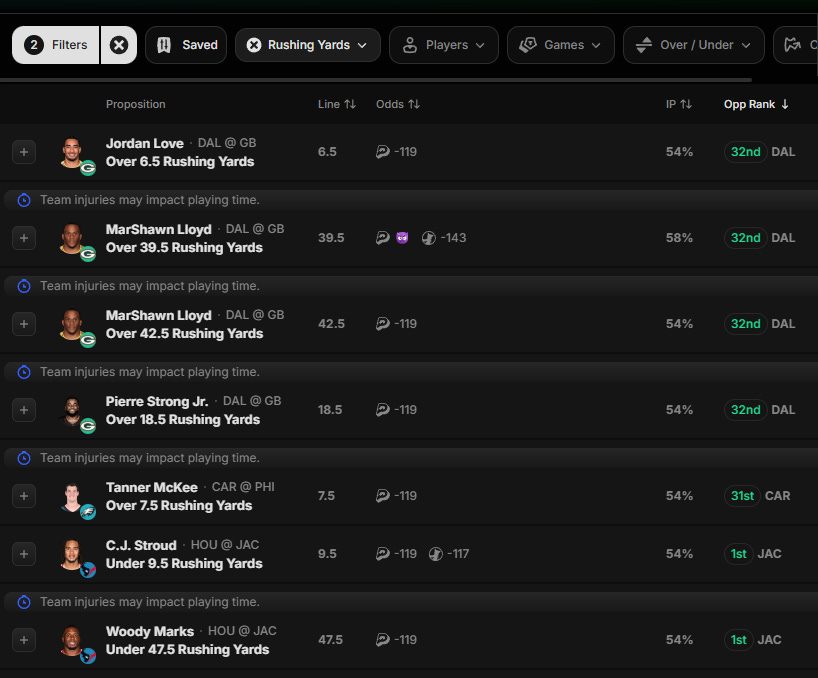
This helps me identify players facing defenses that have struggled against their positions.
For example:
A running back facing a defense allowing significant rushing yardage.
A wide receiver facing a defense that struggles against a particular receiver role.
A quarterback facing a defense allowing substantial passing production.
But there’s an important detail here.
Don’t confuse overall defensive rankings with position-specific rankings.
A defense might be excellent against wide receivers but struggle against tight ends or pass-catching running backs.
That’s why I always open the individual player card instead of relying exclusively on the main rankings screen.
The matchup ranking helps me identify potential opportunities.
It doesn’t automatically make something a good bet.
Step 3: Evaluate the Player’s Hit Rate
Once I find a favorable matchup, my next step is evaluating the player’s historical performance against the available line.
Let’s say a running back has a rushing yardage prop of 57.5 yards.
I want to know how frequently that player has exceeded 57.5 rushing yards.
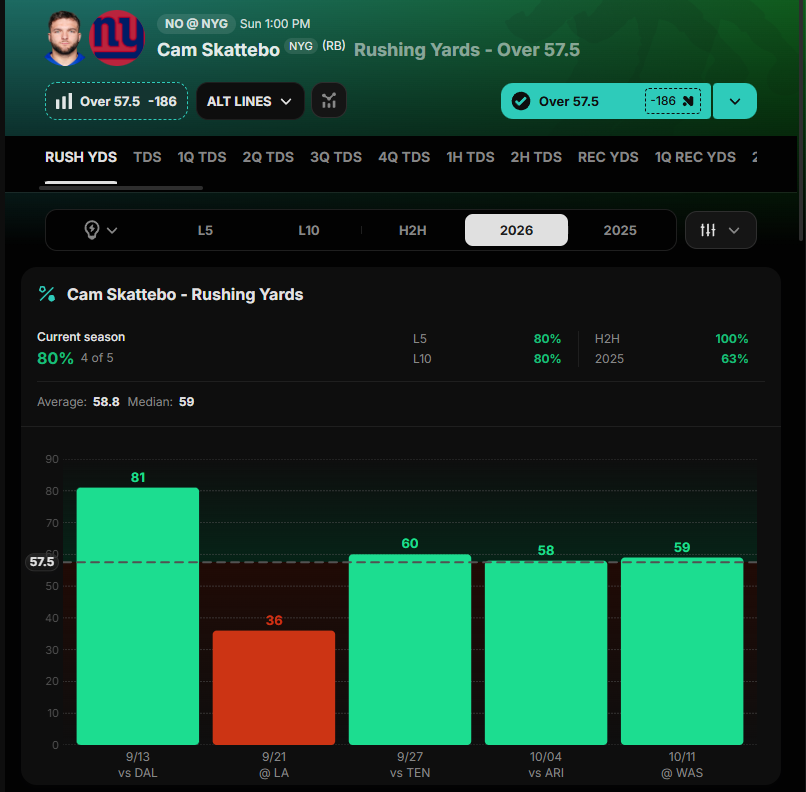
If they’ve gone over the number in four of their last five games, that’s immediately more interesting than someone who has only gone over once.
Inside Outlier, I can filter for hit rates to narrow down the available props.
For example, early in the season, I might look for players with an 80% hit rate at their current line.
However, there is one important distinction.
A High Hit Rate Doesn’t Automatically Make a Good Bet
Consider a player who has exceeded 80 receiving yards in three consecutive games.
That’s obviously encouraging.
But what if the opposing defense has allowed only one tight end to exceed 80 yards all season?
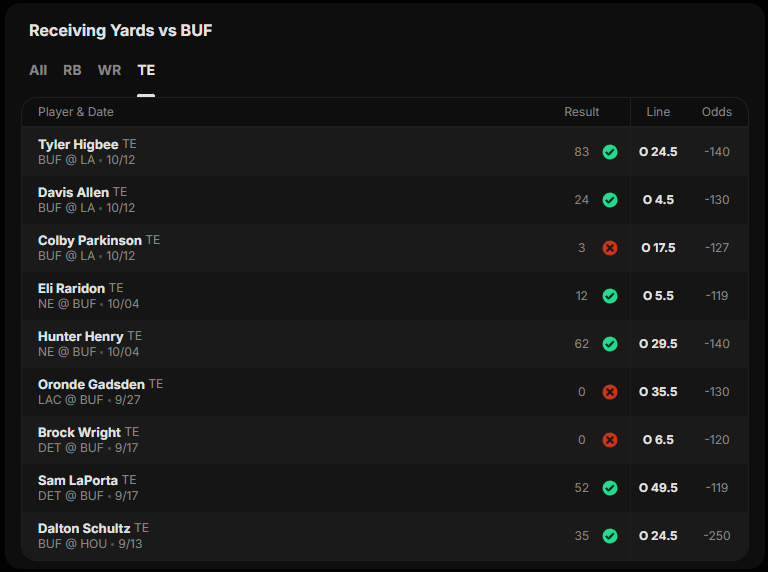
Suddenly, that 100% hit rate doesn’t look quite as attractive.
That’s exactly why I don’t make decisions based on hit rates alone.
Hit rates tell you what the player has done. Matchups help you evaluate whether that production is likely to continue.
And early in the season, small sample sizes make this distinction especially important.
Step 4: Evaluate Opportunity and Volume
This is one of the most overlooked parts of player prop research.
A player can have a tremendous matchup and a strong historical hit rate, but if their opportunity isn’t there, reaching their projection becomes much more difficult.
For wide receivers and tight ends, I look at:
Target share
Recent targets
Team receiving distribution
Depth of targets and receiving routes
For running backs, I look at:
Team rushing share
Role within the offense
Whether the player is receiving consistent rushing opportunities
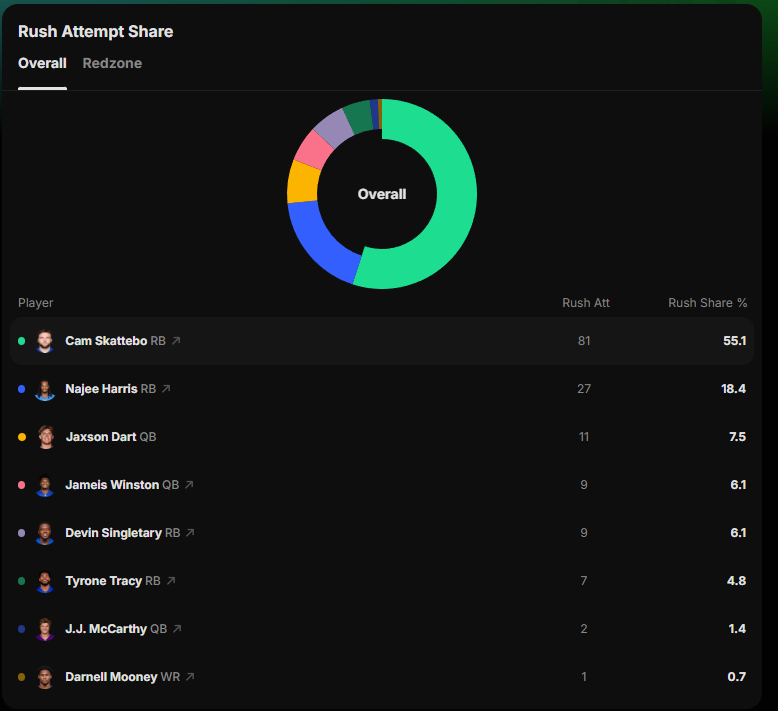
For example, a running back receiving 55% of his team’s rushing work is generally a more appealing candidate than someone splitting carries among three different players.
I’m looking for players who have a realistic path to reaching their number.
A favorable matchup only matters if the player gets enough opportunities to take advantage of it.
Step 5: Study How Opposing Players Have Performed Against the Defense
This is where my research starts getting more detailed.
And quite frankly, I think this is where a lot of bettors stop short.
Instead of simply looking at a player’s season averages or the opposing defense’s overall ranking, I want to see exactly how other players have performed against that defense.
Let’s say I’m evaluating a rushing prop of 57.5 yards against New Orleans.
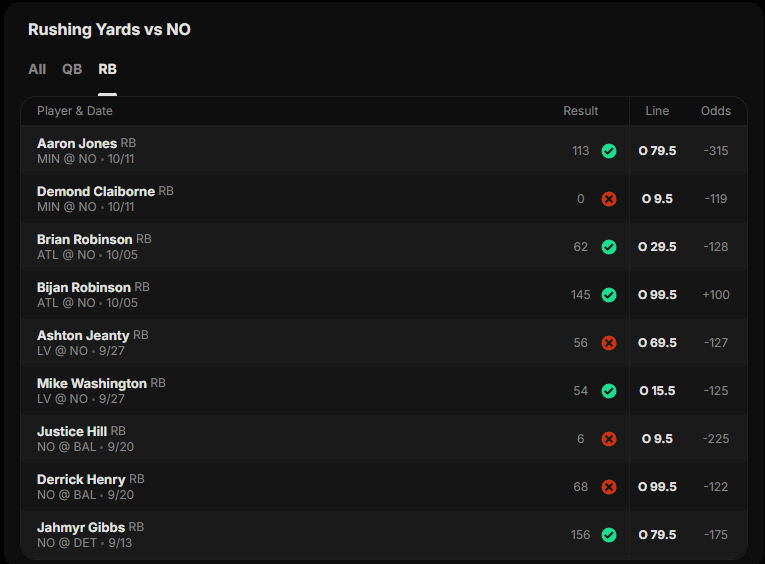
I want to pull up every opposing running back who has faced the Saints and see how many reached that specific number.
That’s something Outlier allows me to research quickly.
Example: Cam Skattebo Rushing Yards vs. New Orleans
One of the plays I highlighted in this video was Cam Skattebo over 57.5 rushing yards against the Saints.
Here’s why I liked the spot.
1. Strong historical hit rate
Skattebo had exceeded this number in four of five games.
2. Excellent matchup
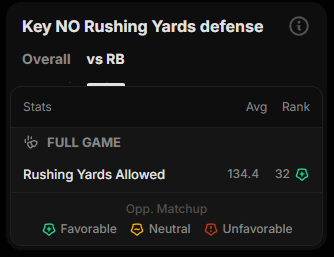
At the time of the research, New Orleans ranked 32nd against running backs in rushing yards allowed, surrendering approximately 134.4 rushing yards per game
3. Consistent opportunity
Skattebo was handling approximately 55% of his team’s rushing opportunities.
4. Opposing running backs were consistently producing
Here’s how several running backs had performed against New Orleans:
Look at those numbers.
Every lead running back in this sample recorded at least 54 rushing yards. Five exceeded 60 yards.
That tells me there’s something particularly interesting about this matchup.
Now combine everything:
Skattebo had exceeded 57.5 rushing yards in four of five games.
The Saints were allowing the most rushing yards to running backs.
He was receiving the majority of his team’s rushing opportunities.
Opposing running backs were consistently producing against New Orleans.
This is exactly the kind of combination I’m looking for when researching player props.
Does that guarantee a winning bet? Of course not.
But I would much rather evaluate a prop supported by multiple pieces of evidence than make a selection simply because someone has hit their over in four straight games.
Step 6: Find Alternate Lines That Offer More Margin for Error
This is probably my favorite part of the entire strategy.
You don’t necessarily need to bet the standard line.
Sometimes, the best opportunity is to lower the line and use that alternate prop as part of a parlay.
Let’s go back to Cam Skattebo.
His standard rushing prop was 57.5 yards.
But what happens if we move that line down to 34.5 rushing yards?
Suddenly, the historical data becomes even more compelling.
Skattebo had exceeded 34.5 yards in all five games.
Every running back in our New Orleans sample had exceeded that number.
The matchup remained extremely favorable.
His offensive role remained unchanged.
That’s the type of alternate line I love targeting.
Instead of needing 58 rushing yards, I only need 35.
Obviously, you’re sacrificing payout by choosing a lower line.
But when I’m building parlays, I’m often looking for these situations where the player has a strong opportunity to exceed a relatively modest number.
My Alternate Line Strategy
Here’s how I approach alternate lines:
Find a standard player prop with a favorable matchup.
Evaluate the player’s hit rate and opportunity.
Check how opposing players have performed against that defense.
Gradually lower the line until I find a number supported by a strong historical profile.
Compare the payout across the available platforms.
The goal isn’t simply to find the lowest possible number.
It’s to identify a line where the historical evidence is particularly strong relative to the price being offered.
Remember, even a player with a 100% historical hit rate can lose their next bet. You still need to consider whether the payout makes sense.
Step 7: Don’t Ignore Kicking Props
One of my favorite examples of this strategy involves NFL kicking points.
These aren’t necessarily the most exciting props to research, but they can offer interesting alternate-line opportunities.
Example: Jason Myers Over 4.5 Kicking Points
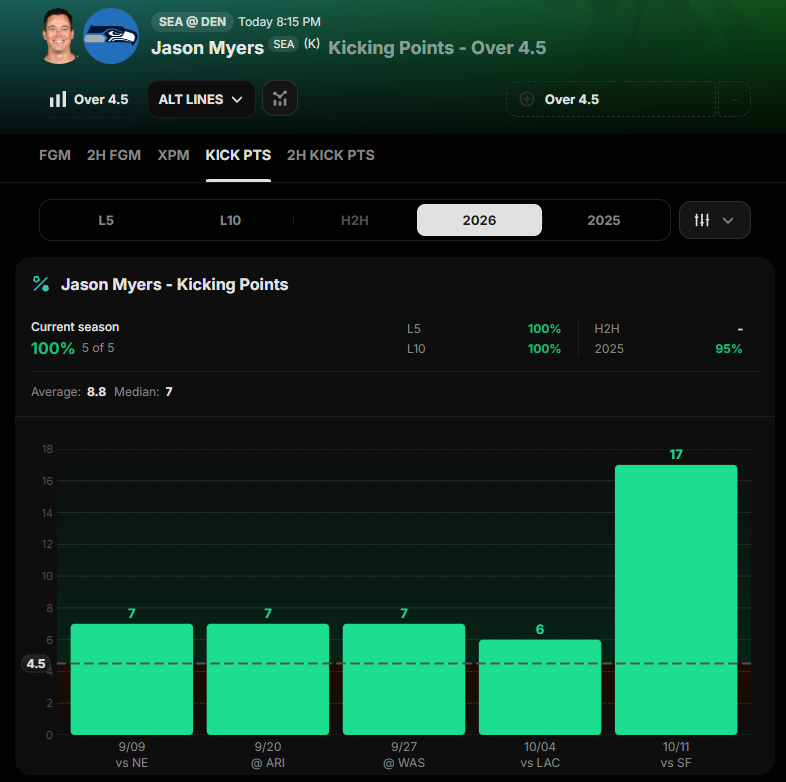
For the Seahawks vs. Broncos Thursday Night Football matchup, I identified Jason Myers over 4.5 kicking points as an interesting play.
First, let’s look at his historical performance.
At the time of my research:
Myers had reached at least five kicking points in all five games that season.
He had reached that number in 19 of 20 games the previous season.
That caught my attention.
But I wanted to see how other kickers had performed against Denver.
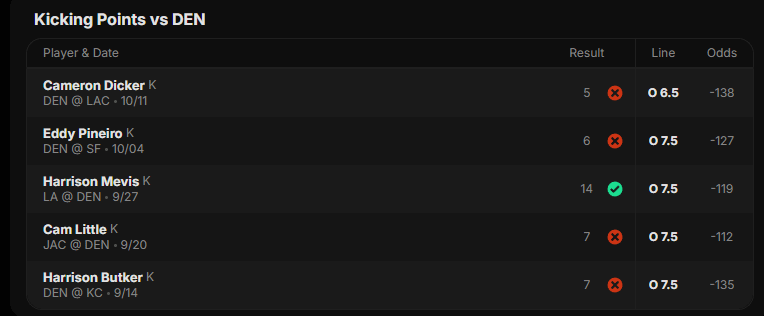
Every kicker in that sample had recorded at least five points against the Broncos.
That’s exactly what I wanted to see.
Myers had been consistently producing kicking points, and every opposing kicker in the sample had reached the same threshold against Denver.
One important distinction here is that kicker matchup rankings can be misleading.
A team’s overall ranking against kicking points isn’t always as useful as reviewing how individual kickers have actually performed against that team.
Kicking opportunities also depend on scoring drives, field goal attempts, and game conditions, so I don’t treat these historical results as guarantees.
Still, this was another example where the historical trends and matchup data aligned.
Step 8: Filter Receiving Props by the Starting Quarterback
This is a smaller detail, but I consider it extremely important.
When evaluating wide receivers and tight ends, I want to know who was playing quarterback during their historical games.
A receiver might have a mediocre hit rate over their last ten games.
But what happens if four of those games were played with a backup quarterback?
That can completely change how I interpret the data.
Example: CeeDee Lamb Longest Reception
One prop I frequently like researching is CeeDee Lamb’s longest reception.
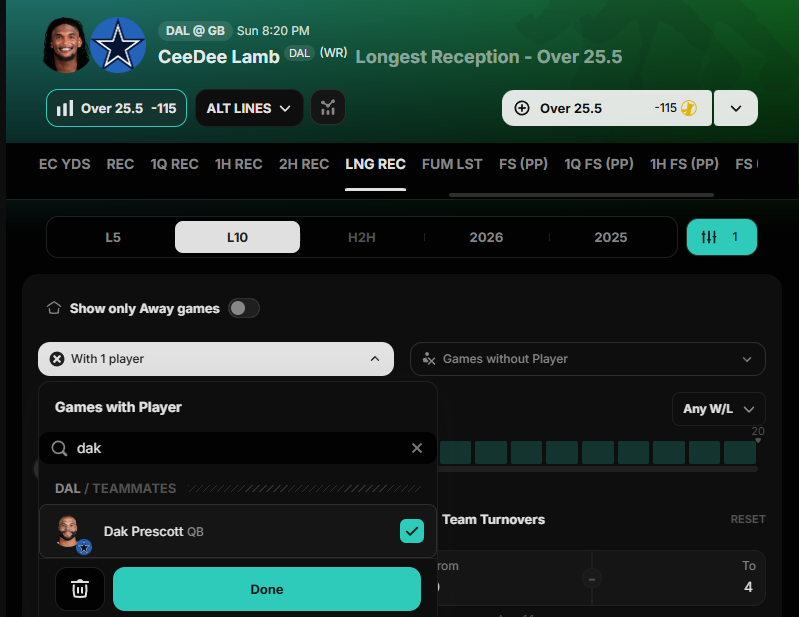
In this video, his longest reception line was 25.5 yards.
When filtering for games played with Dak Prescott, Lamb had exceeded that number in nine of fourteen games.
But even that doesn’t tell the full story.
Some of those misses included games where:
Lamb was injured.
He finished with only one reception.
Prescott left the game with an injury.
Those details matter.
A player missing a prop because he was injured in the first quarter isn’t the same as a player receiving ten targets and failing to produce.
That’s why I recommend filtering receiving props by quarterback whenever possible.
Context matters more than simply counting green and red boxes on a betting research tool.
Step 9: Be Extremely Selective With Your Bets
Here’s something I want everyone to understand.
I don’t need to find 100 NFL player props every week.
I don’t even need to find ten.
I’m looking for a small number of situations where I feel the available information gives me a compelling reason to make a bet.
Sometimes, a player has a great hit rate but a difficult matchup.
Sometimes, the matchup is outstanding, but the player isn’t receiving enough opportunities.
And sometimes, every historical trend looks incredible, but the line or payout just isn’t attractive enough.
You don’t need to force a play just because you’re researching a game.
That’s why my process takes time.
I’ll go through individual player cards, compare matchups, review opposing player performance, and build a shortlist.
Then I’ll compare those options before deciding which ones I actually want to play.
The goal is quality over quantity.
And while being selective doesn’t eliminate variance or guarantee profitability, it helps prevent me from betting simply because there’s a game on television.
My Complete NFL Player Prop Research Checklist
Here’s a quick checklist you can use when researching NFL props with Outlier.
Before making a selection, ask yourself:
Is the opposing defense a favorable matchup for this position?
Has the player consistently reached this number?
Does the player receive enough opportunities?
Have similar players reached this line against the opponent?
Are there injuries or quarterback changes affecting the historical data?
Is there a better alternate line available?
Does the price justify the risk?
Am I making this bet because I like the research, or am I forcing action?
The more questions you can answer confidently, the stronger your understanding of the potential bet becomes.
That doesn’t mean every box needs to be checked.
It means you should understand exactly why you’re making the selection.
Final Thoughts: The Tools Don’t Find the Winners for You
I think one of the biggest misconceptions about betting research tools is that you can purchase a subscription, turn on a few filters, and suddenly become a profitable bettor.
It doesn’t work like that.
Outlier is incredibly useful because it puts so much historical data, player information, and matchup research in one place.
But you still need to interpret that information.
For me, the process is straightforward:
Matchup → Hit Rate → Opportunity → Opponent History → Line Value
That’s the foundation of my NFL player prop research.
I use essentially the same process throughout the entire NFL week, whether I’m researching Thursday Night Football, Sunday games, or Monday Night Football.
It takes time, but I would much rather put in the extra work than make bets without understanding what I’m actually betting on.
If you take one thing away from this article, let it be this:
Stop looking for props that simply have good hit rates. Start looking for props where the matchup, historical production, opportunity, and price all make sense together.
That’s where meaningful research begins.
Want to Try This Strategy Yourself?
I use Outlier for researching NFL, NBA, WNBA, and college football player props.
If you haven’t tried it yet, you can sign up through my referral link to see the available free trial offer. Trial lengths and promotions are subject to change.
Replace this link with your personal Outlier referral URL before publishing.
Want My Actual Picks Instead?
If you’d rather follow my daily picks instead of doing all the research yourself, you can join LayTheHouseRM VIP.
VIP members get access to my posted player props, parlays, and picks across the sports I cover, along with access to the VIP section of my Discord.
You can also follow my free content on YouTube, where I post betting strategies, research tutorials, and picks throughout the year.
As always, bet responsibly. Historical trends are useful research tools, not guarantees of future performance. No strategy eliminates the possibility of losing money.
Best of luck on your bets, everybody!
LayTheHouseRM